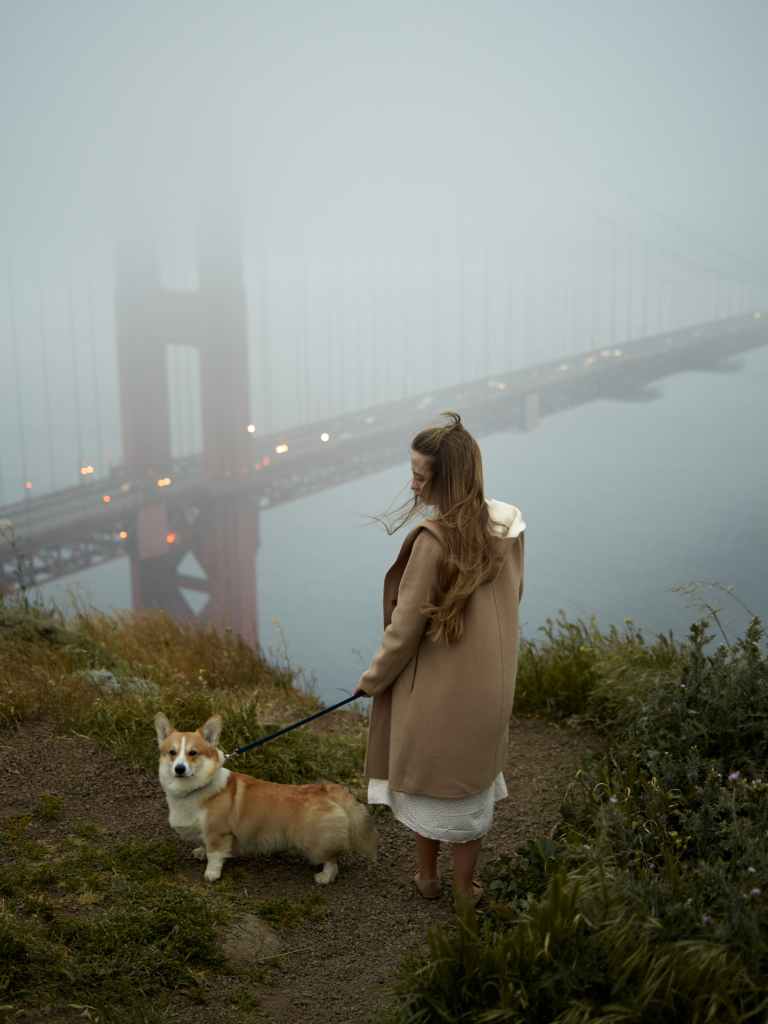
Now, I know the Gold Standard of canine obedience is a strict heel, off-lead – and such a thing is magnificent and gains nothing but respect from me. My own dogs always have a good off-lead heel walk as a minimum standard for me, because it’s a good thing to teach and learn… but do I have my dogs off-lead heeling in public?
Absolutely not.
My dogs walk by my side on a loose lead, or trot about a little further afield, on a long lead, if we go to a public park. The time they get to be off the lead to run around is when we’re in enclosed fields, gardens, and paddocks, with known people and animals. Of course, the risks that come with my dogs being off-lead in public are still pretty low, I’m pleased to say – but they’re not low enough for me to justify it.
Now, as that breed guy, you knew I was going to bring breed into it. My dogs, when off-lead, don’t sprint off for miles – because they’re close-quarters guardian dogs, of mastiff-type. They’re not super-high-energy and they like to stay close to me. They rarely even get to the end of my twenty-foot long lead. With higher-energy, more exploratory and enterprising breeds, I don’t take much of an issue with letting a dog off the lead to run around, if you’ve done a good scan of the area and have impeccable recall. I’ll discuss the minimum criteria for letting a dog off-lead later on in the post – but in the meantime, let’s have a look at why keeping your dog on-lead might well be best practice for most of us, most of the time!
I’m going to give you four real-life, really common scenarios – some of which I’ve found myself in – to demonstrate the real-life relevance of the lead as a safety device.
Scenario 1

So, for Scenario 1, which is one I’ve been in, let’s picture the scene. It’s a beautiful summer’s day and you’ve just walked with your faithful pooch at your side to get an ice-cream from the creepy jingling van – because you are “forever young” as Bob Dylan told you. Now, you’re heading home with your tasty treat, pooch still at your hip and on the lead – but to get to your front door, you need to cross a road. There are cars coming from both directions, but they are few and far between – so there’ll be space to nip across after a few seconds of waiting. Your dog, being a model citizen, of course, is in an auto-sit at the roadside while you wait. It’s a dreamy scenario, I know.
But here’s the problem. Coming from your right is a large electric car driving at about forty miles per hour. The driver has lost control of the vehicle and the car mounts the pavement as it approaches you, at speed. Your dog hasn’t seen the vehicle but you have (neither of you heard it approach, though – damn ozone-sparing electric vehicles!). You have half a second to get your dog out of the way – no time to wait for it to notice and react for itself, and no time to squat down to pick your dog up. All you can do is jerk the lead back as fast as possible to pull your dog out of harm’s way as you throw yourself backwards too… and hope for the best. I managed to save the life of my mum’s spaniel, Pippin, in this manner, in this exact scenario, in 2014… tragically, though, the ice-cream did not survive.
A car riding the curb is rare, yes – I know. A dog with less acute hearing and slower reactions than you, with your puny human senses, is also rare – perhaps even rarer. I don’t care. This happened to me and situations like it happen every day, the world over. The lead in this context is there as a last-resort safety feature to pull your dog out of harm’s way – whatever that harm looks like – and I wouldn’t ever want to be without it. Remember: it’s not just out-of-control cars that can come out of nowhere to pose a risk to your dog.
In fact, that’s exactly what we’ll be learning in the next one.
Scenario 2
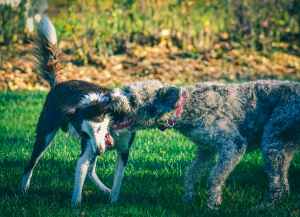
So, next up is Scenario 2. I’m sad to say I’ve also been in this unfortunate scenario myself, only last year – and I was grateful for the lead. So, here it is: you’re out walking your extra-large dog at the local park; the lead is attached, as always. Your dog is a “gentle giant”: seventy-five kilos of love and zero kilos of animosity – which is good news, because from behind a thicket an angry Cockapoo has appeared. It is off-lead, and off its rocker. It makes for your dog like a bullet disguised as a piece of fried chicken. The hapless owner watches on, shouting, as the dog bites your dog repeatedly in the throat, with no response from your dog other than fear and an attempt to bolt, while you hold on for dear life. The Cockapoo’s owner is doing nothing but squawk, so you end up having to step in, pulling the stranger dog off yours by its scruff and returning it to the owner by hand, where it is hastily returned to its lead.
In this scenario, when it was me and my Mastín, the lead served as a tool for preventing my dog running away – perhaps into the path of more danger, perhaps not – a behaviour I’d never yet seen from him, the gargantuan livestock guardian once tasked with the dispatch of Iberian wolves. Honestly, he was even worse when he first heard fireworks. BUT, back to this: the lead was a way of keeping him close-by… but it could have been so much more than that if my dog had responded more appropriately, and fought back. The attacking dog was one tenth the size of my boy, and would’ve been killed instantly in one clamp of his jaws. If my dog had been inclined to respond (as some of my past dogs would’ve done, to a blatant and unprovoked attack like this), the lead would’ve given me a means of controlling any violent retaliation. The lead doesn’t just keep your dog safe, but others around it.
And what’s more, because of the enormous size-difference between the dogs, the law would certainly not have been on my side had any damage been done to the smaller dog, if Jackson had been off his lead at the time. It’s a legal requirement in this country that your dog be “under control” at all times – but prosecutions and fines only ever really land when a powerful breed causes damage. This isn’t the playground; who “started it” means nothing at all when the outcome is serious and asymmetrical. So I consider the lead also to be something of a route to indemnity in situations like this… because they’re not uncommon.
Suffice it to say, I didn’t sue the Cockapoo owner.
Scenario 3
Okay, so now let’s look at Scenario 3. I’m pleased to say I’ve NOT been in this situation out in public. I have been in this situation in the home, though, where grabbing the COLLAR of the giant Boerboel attempting to savage my landlord who’d let himself in unannounced, was the key to management, not a lead – but close enough. The Scenario is highly breed-dictated, you’ll be unsurprised to hear me say – so I’m going to keep it vague and generic… more of an abstract reasoning problem than a scenario, I guess! It’s about when the drive to “be a dog” conflicts with societal expectations.
The situation is this: your otherwise impeccably-behaved dog is met with an unforeseen trigger to a competing drive, deeply ingrained in the canine genome. Your Greyhound sees a rabbit crossing its path, perhaps. Your Pitbull is faced with a well-intentioned but overzealous dog running up to greet it. A sheep has escaped its field and is bouncing around in front of your German Shepherd or Husky, bleating in terror. Without the help of an E-Collar (likely soon to be banned in this country), the dogs’ deeply ingrained drives are almost always going to be stronger than your words (even if your training up to this point has been pretty good) and the reality is: a dead animal is coming your way, in a matter of seconds. It’s not that you’re a poor owner if you can’t call your dog away from predation or combat; it’s just that centuries and often millennia of selective breeding for these traits are more influential. It’s hardwired. They’re seeing red, not seeing you.
In a case like this, a case of the unexpected appearance of prey or adversary, in front of your perhaps unexpectedly “drivey” dog, the lead is your best friend and only method of controlling at least one side of the exchange. It is a management tool for the unexpected. If you can pull your dog away on the lead, before it delivers a fatal bite, you’re going to be relieved. If you can’t, there’s a chance you’re going to be in court. (Yes, in allowing your dog to be out of control and kill another animal, you may very well have committed a crime.)
And, on the subject of crime, let’s move to the final scenario.
Scenario 4
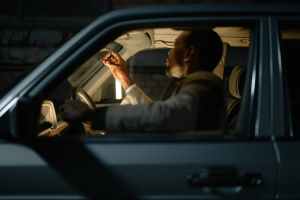
For the last one, Scenario 4, we’re in a context I’ve fortunately also not found myself in (perhaps it’s a breed selection thing… hmm…). Picture this. Your brand new, beautiful Frenchie (the current most popular dog in this country, and one of the most portable breeds in existence today) is trotting alongside you on your evening stroll through the suburbs. It’s taking in the world via its snuffly little nose and having the time of its life. It goes over to sniff the enticing glisten of another dog’s urine on a nearby idling car wheel that you’re passing.
Little do you know that the car is idling because there’s someone sitting in it. Little do you know that they’re sitting in it so they can hop out at speed and grab your dog, to sell. But little do THEY know that your dog is on a lead… and as soon as you spot the culprit exiting the car to snatch your pride and joy, you pull the lead hard and fast and reclaim your dog, before picking it up and fleeing. Foiled again, dognapper! Attempted theft – particularly of French Bulldogs, so the statistics say – is sadly very common. Often, your lead is the only thing keeping your baby attached to you… kind of umbilical, when you think about it.
So, in sum, having a lead on your dog in public can keep your dog safe from injury and theft, other dogs and animals safe from yours, and you safe from a legal battle. They are, in short, a safety measure, and I don’t think there are many PUBLIC contexts in which an off-lead dog is appropriate. It’s worth mentioning, by the way, that these emergency situations are also ones in which you cannot remain “force free” – because management can sometimes entail physical distress.
Criteria for being off-lead
Still, because I know there are lots of people who want their dog to be off-lead at times, I thought I’d share my criteria for being off-lead. If you can ensure all four of the following conditions, you’re going to mitigate the majority of the risk.
- The location must be predictable and green (a familiar walk with a consistent creature population).
- The visibility must be good (preferably flat, and not currently occupied by strangers, either man or beast).
- The dog in question must have extremely good recall, and low drive (in case of visibility letting you down).
- The owner must be ready to accept responsibility for their dog’s off-lead behaviour (both morally and legally).
So, if you are in a familiar location, with familiar company, with your recallable dog, then you can feel more comfortable with unclipping the lead – but I’d still prefer to save off-lead time for when you’re in an enclosed area (which you can rent for peanuts) and use a long lead as an often sufficient middleground.
Okay, but you’re probably wondering: why am I so anal about this? It’s not a big deal to most people.
Well, it becomes a big deal when you’re faced with the consequences of an off-lead dog’s behaviour. I hope that most people whose dogs go off-lead in public never have to end up in a horrific situation, but I’m going to stack the cards in my favour by sticking to the lead as a back-up – particularly as an owner of giant breeds who intrinsically come with greater liability.
Every day, I’m hearing about off-lead dogs killing sheep in Wales; about pedigree dogs being stolen in broad daylight when they’re off their leads; about free-roaming dogs being involved in sometimes fatal dog fights. Whilst the risk for the individual remains low, the overall incidence is high. You may get lucky and never face consequences; or you may get unlucky and get caught out. Worst-case scenario: you lose your dog.
Well, not on my watch.
How to be “on-lead”

So, how do you become an “on-lead” owner?
Well, the first step is to teach a loose-lead walk. Once you’ve done that (and the world is full of trainers, many of whom have YouTube channels or online courses, who can teach you that), there are only a few key things to bear in mind – my five golden rules for happy, low-conflict dog walks:
- Your dog should wait at thresholds (gates, roads, bridges, etc.) – an automatic sit is a nice way of gaining clarity with this, but is not a necessity.
- Your dog should be allowed to sniff, generally (it’s so good for them), but should return to your side regularly and not drag you around.
- Your dog should respect that not all dogs wish to interact (and many owners forbid it), so you should aim to pass fellow dog-walkers with your dog on the opposite side of your body to the stranger (always ask “are they okay to say hello?” before any meetings do happen).
- Your dog should not feel tension through the lead except for communication purposes – and certainly should not be held taut whenever other dogs pass unless you want to teach your dog to stress about strangers.
- Your dog should enjoy walks as the best part of their day, so that means that as soon as the lead is on, that’s your cue to put aside the stresses of the world and just enjoy the bonding experience with your dog – not allowing your frustrations with life to travel down the lead to your pup.
And that’s it. If you can commit to a lead, commit to loose-lead walking, and maintain the five golden rules of respectful dog walking, you’ll be well on your way to responsible dog ownership!
Lead the way.
 That Breed Guy